TCOE supports Climate Week

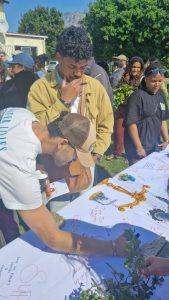
On Saturday 05 September, the Trust for Community Outreach and Education had a special stall at its monthly smallholder farmers’ market in Mowbray. As part of Cape Town’s Climate Week 2026, TCOE hosted an exhibition stall to promote climate activism and raise awareness of climate change. A special banner reminded everyone that there is only one planet Earth.
It featured a striking central visual image reminiscent of the scales of justice, with the Earth on one side and a modern extractive factory and related industrial development on the other, with ample white space around the image inviting people to write their own messages of support and climate activism.
The monthly Farmers Market takes place on the first Saturday of each month, and this month it falls on 5 September, the last day of Climate Week.
Smallholders and backyard farmers come from as far afield as Zolani outside Robertson, more than an hour’s drive from Cape Town. Beyond that lies Suurbraak, a three-hour drive away. Yet all these farmers are happy to make the journey once a month, as for some of them, Mowbray Market is where they can sell most of their produce.
Like 72-year-old Tannie Elsie Sauls, a seed saver and backyard farmer who has farmed for over 20 years and has experienced first-hand the effects of climate change on her harvests of sweet potatoes, spinach and more. She says she plants whatever she can; “If I can grow it, then I will plant it,” but in recent years she has struggled with either too much rain, which means she is unable to plant as the soil will not hold the seeds, or no rain, and it is too hot for the seeds and seedlings to survive. In 2023, Greenpeace reported that mean annual temperatures – both hot and cold – in South Africa had increased by twice the global average.
While Keshia Leanard, from a fishing village in Buffeljagsbaai, says the sea temperatures mean her community is seeing fewer fish – the water is either too cold or too hot. Both extremes mean the fish either aren’t biting or are leaving the area.
She adds that climate change has also led to a greater variety of fish and marine life in their waters, and not all of them are edible.
As early as 2019, WWF South Africa reported dwindling catches among small fishing communities. The battle was due to changes in water temperatures and ocean acidification, which were altering migration patterns and survival rates of coastal wildlife, forcing fishermen to venture further and more often to bring home enough of a catch to feed their families.
Abigail Jacobs, from Robertson, is a backyard farmer and has been one for about 10 years. She says climate change is very present in her experience, as she not only has smaller crops but also less work. Coming from a farming area where work is often seasonal, depending on the season and the crops, climate change and unexpected weather events have, in recent years, meant fewer crops and less work. For her, she can make in one day at the market what she would generally need to generate in two to three days.
Babalwa Phillies does not have to travel as far as other small-scale farmers to reach the market, as she has a small farm near Crossroads where she grows spinach, carrots, leeks, spring onions and butternut in season. For her, the market is a lifeline, as she is unemployed except during planting and harvesting, and she earns most of her monthly income from TCOE’s market.
In June 2025, Stellenbosch University Business School wrote:
“The impacts of climate change threaten a 50% decline in South Africa’s agricultural production by 2050… Maize is a staple food source for poor households and is already showing annual price increases of 30% due to climate impacts on agricultural production.”
Several organisations organised workshops and activities, including promoting community action for climate justice and a sustainable future.
TCOE promotes environmental activism as part of its sustainability efforts and teachings to promote food sovereignty. It also actively supports rural communities in their efforts to enable these economically struggling communities to feed themselves and their families by producing their own food, supporting agroecology hubs, community food gardens, seed-sharing networks and alternative local markets.
Over the past three months, the organisation has also supported farmworker communities devastated by floods and storms across the Robertson, Worcester and Rawsonville areas, extending to Suurbraak.
The organisation is committed to empowering communities to control their own food systems, food production chains, and spaces. “TCOE advocates for climate justice through policy reviews and submissions, campaigns for climate justice, and supports climate advocacy.”