One Woman, One Hectare: Where to Now for Rural Women’s Food Security?

By Agnes Mokhele
12 years after the Rural Women’s Assembly (RWA) launched the One Woman, One Hectare campaign, rural women continue to demand secure land rights, affordable water, and agricultural support to feed their families and build independent livelihoods. Although women have reclaimed neglected spaces for food production, access to land does not always translate into secure rights or the resources required for farming.
Their experiences raise a critical question: How much progress has been made, and what will it take for rural women to achieve food sovereignty?
From neglected spaces to demands for land rights
The One Woman, One Hectare campaign calls for every woman to have a hectare of land registered in her name, with the authority to decide how it is used and how production income is spent.
According to RWA South Africa coordinator Norah Mlondobozi, members across the country have transformed spaces such as illegal dumping sites and vacant land into sites for agricultural production. These efforts demonstrate women’s determination to produce food and to strengthen local food systems despite limited access to agricultural land.
However, access to land for cultivation does not necessarily secure land rights. Mlondobozi said women continue to struggle to obtain formal documentation confirming their land rights in their own names. “We want a hectare for a woman, and it should be registered in the woman’s name,” she said.
She also questioned approaches that allocate land to households rather than to individual women, arguing that patriarchal household structures can leave men in control of land and production decisions. “The woman should be in control of that hectare, not the household, not the men but the woman,” Mlondobozi said. Her concerns stem from her own experience. Despite spending more than 20 years on a farm, she said she still lacked documentation confirming her land rights.
For the campaign, the issue is not simply whether women can cultivate land, but whether they can control it and build secure livelihoods without needing others’ permission.
Growing food amid rising household costs
For Nomvuselelo Baso, growing food is an important way to reduce household expenses amid rising food prices and limited income. She lives in a household of five, and her son is the sole earner. Since losing her job, she has relied on other income-generating activities, including selling eggs, while maintaining a food garden to supplement the household’s food supply. “I have my own food garden, so I don’t have to buy everything from shops,” she said.
Despite these efforts, Baso spends approximately R1 000 to R1 500 a month on food, and the money does not last until the end of the month. Other household expenses, including electricity and municipal rates, add to the financial pressure. Water is another obstacle. When rainfall is insufficient, Baso relies on municipal water to irrigate her garden, but the cost makes continued production difficult. “You have to choose between paying a high water bill and stopping food production, which would make the situation even worse,” she said.
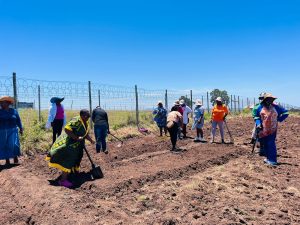
Baso called for municipal water tanks or other forms of water support for women who produce food, noting that access to affordable water can determine whether a household garden remains productive. Her experience highlights a broader challenge: food gardens can reduce dependence on purchased food, but women cannot sustain production when essential resources become unaffordable.
Land alone cannot guarantee food security
Agricultural expert Professor Marc Wegerif emphasised that secure land rights are fundamental to improving women’s food security and livelihoods. “Access to land and secure rights over it are a foundation for many women to achieve food security and better lives,” he said.
Wegerif also highlighted the relationship between women’s land rights and food sovereignty, noting that unequal land rights and limited participation in agricultural production and decision-making hinder people’s ability to shape their food systems and influence how food is produced and distributed. He argued that meaningful food sovereignty cannot be achieved while women have unequal land rights and limited participation in agricultural production and decision-making.
Government commitments and implementation
At the Free State Women in Agriculture Imbizo in Botshabelo on 15 September 2026, Agriculture MEC Elzabe Rockman said the department was working to allocate at least 50% of Comprehensive Agricultural Support Programme funding to women and 40% to young people, as reported earlier by Inyanda News.
At national level, Agriculture Minister Willie Aucamp proposed identifying 100 qualifying farmers in each province for possible transfers of ownership of government-owned agricultural land, arguing that ownership could improve access to finance. The proposal was not specifically directed at women. For the One Woman, One Hectare campaign, the question remains whether government initiatives will translate into secure land rights, affordable water and meaningful control over agricultural resources for rural women. At the time of writing, the relevant department had not yet responded directly to the questions raised in this article.