Rural Women’s Assembly awarded the ‘Alternative Nobel Prize’

The Rural Women’s Assembly says it is humbled to receive the award from the Right Livelihood for its work defending land and seeds and resisting corporate and patriarchal dispossession. Founded in 2009, at the height of the food crisis caused by the global economic crisis, the Rural Women’s Assembly is one of the four recipients of the Right Livelihood Awards, also known as the “Alternative Nobel Prize”.
The other recipients are a Pakistani lawyer, an AI researcher born in Ethiopia but based in the US, and the Georgian Young Lawyers’ Association.
The Right Livelihood Award has been recognising individuals dedicated to promoting social justice and environmental issues for more than 40 years, with a particular focus on changemakers from the Global South.
Mercia Andrews, the regional coordinator for Rural Women’s Assembly, said at the press conference honouring the award recipients that the award highlights the challenges rural women face.
“It’s a great honour to receive this award. I think we feel very privileged to be a recipient of this award because it will give much greater visibility and focus to the struggles of rural women, who are often invisible in faraway villages,” said Andrews.
“Our aim is to be able to say that women have agency, have shown their resilience, and have shown remarkable strength in organising themselves, in fighting poverty and hunger, and, most importantly, in contributing extensively to the food systems that we have,” she said.
Zakithi Sibandze, the Eswatini Chapter Leader of the Rural Women’s Assembly, told reporters that the award confirms the value of their work.
“For me, it really means solidarity. The word that comes first is solidarity with the women, which I’ve seen many times, with women supporting each other in cases of climate crisis. On the land rights issue that was happening at my own home, all the women rose up, stood up, and supported me. So that is why the first word for me was solidarity, in terms of the movement, the numbers, and the support that is there,” Sibandze said.
Fighting for land, seeds and access to food
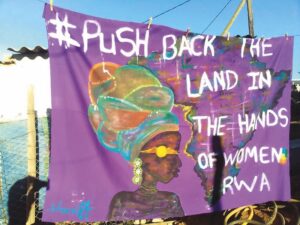
Lungisa Huna, the South African Chapter Leader, stated that they have leveraged existing policies to advocate for women’s land rights. Since 2015, they have been campaigning under the ‘One Woman, One Hectare’ initiative. Huna also mentioned that RWA submitted a report to the United Nations’ Universal Periodic Review (UPR) in Switzerland, highlighting issues related to the Right to Food, the Right to Land with Water, and the Right to Seeds.
“So, we all know South Africa is still a country where land reform is a major issue. Since 2015, this campaign, called One Woman, One Hectare, has never given up. They are still fighting today for at least one woman to get a hectare of land. They’ve even taken it further by challenging the South African government through the Universal Periodic Review and putting UNDROP at the centre, which is the Declaration for the Rights of Peasants and Other People Working in Rural Areas, placing the question of land, the right to land, the right to food, and the right to seeds at the centre,” Huna said.
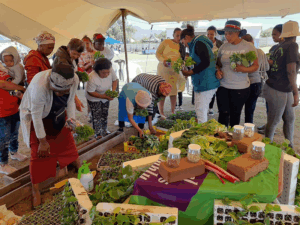
According to Andrews, building alternatives is one of the strategies that RWA has and continues to use. “Key to us is that some of the strategies are about building alternatives. Seeds are being criminalised; we say, let us build seed banks. Organising a counter-seed system,” she said.
Fighting patriarchy and surveillance
According to Sibandze, women who organise around land rights in Eswatini face patriarchal norms and resistance from men, even though the constitution allows women to own land.
“An example is when I wanted to get land in another area, and the requirement was for me to go and request a letter from the current area of my parental home, so that they write that I am a well-behaved person and that I can be accepted. They completely refused, because I was participating in challenging issues of land rights within my community, which was also personal. So those are the discriminations that you already face, and even family members then discriminate against you and sideline you if you don’t conform to the cultural expectations,” she said.
Eswatini is Africa’s last absolute monarchy, and rural poverty stands at 71%, whilst the King spent millions on his ruby jubilee earlier this year.
Sibandze shared a story about ongoing surveillance and intimidation by the police. “I remember that in April we held a mass protest. We wanted to deliver a petition to the Ministry of Agriculture, but they denied us a permit to hold the protest. We had to use the pavement because it had to happen. After the protest, plainclothes police officers came and asked questions. I assume they were with us throughout the protest because you wouldn’t recognise them. They were in plain clothes. And then they came to me, asked what we were protesting about, and requested my number. That’s when it was already surveillance, and then after they went to the Ministry of Agriculture, they requested the petition and photocopied it,” she said.
Rural Women’s Assembly is a regional movement in 11 countries: Tanzania, Zambia, Malawi, Zimbabwe, Namibia, South Africa, Eswatini, Lesotho, Mozambique, Madagascar and Mauritius.
The award ceremony is expected to take place in December.